
Using Tube Lenses with Infinity Corrected Objectives
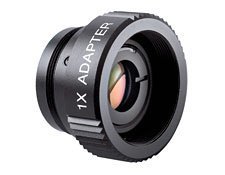
In order to create an image with an infinity corrected objective, a tube lens must be used to focus the image. One advantage to using an infinity corrected objective with a tube lens is that there can be a space between the objective and tube lens. The space allows additional optical components to be inserted into the system, such as optical filters or beamsplitters. The distance between the objective and the tube lens (L) can be varied, but this will affect the image field diameter (∅). Equations 1 and 2 are approximation formulas to determine the relation between ∅ and L.

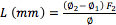
Where,
∅1 (mm) is the exit pupil diameter of the objective
∅2 (mm) is the entrance pupil of the tube lens
F1 (mm) is the focal length of the objective
F2 (mm) is the focal length of the tube lens
NA is the Numerical Aperture of the objective
Application Example
Question: Using an M Plan APO 10X objective (#46-144), MT-1 tube lens (#54-774), and a 2/3” sensor camera, what is the maximum spacing between the tube lens and objective without vignetting?
Answer: The focal length of the objective (F1) is 20mm and NA is 0.28, so the exit pupil diameter can be calculated:

A 2/3” image sensor features an 11mm diagonal, therefore ∅ needs to be at least 11mm. The focal length of the MT-1 tube lens is 200mm and the entrance pupil diameter is 24mm. Therefore,

As long as the spacing between the tube lens and objective is less than 232.7mm, there will be no vignetting.
版權所有 © 2026 江陰韻翔光電技術有限公司 備案號:蘇ICP備16003332號-1 技術支持:化工儀器網 管理登陸 GoogleSitemap


